2005 AMC 12A Problems and Solution
- 格式:doc
- 大小:935.50 KB
- 文档页数:19
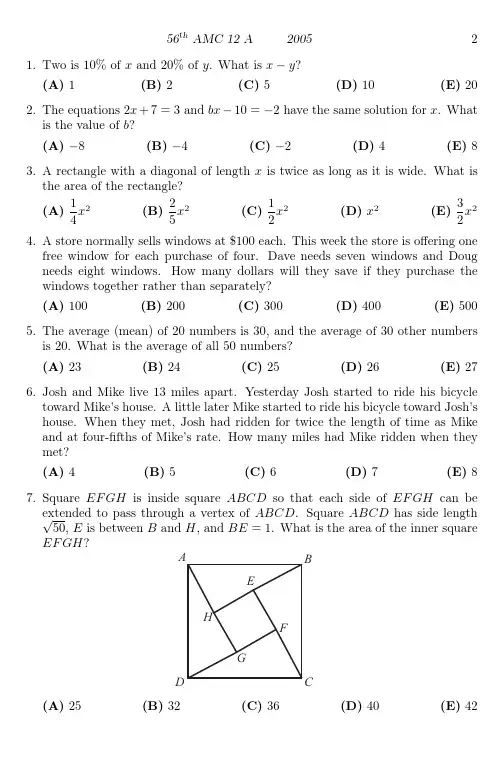
2005 AMC 12A Problems and Solution Problem 1Two is of and of . What is ?Solution. Problem 2The equations and have the sam e solution. What is the value of ?SolutionProblem 3A rectangle with diagonal length is twice as long as it is wide. What is the area of the rectangle?SolutionLet be the width, so the length is . By the Pythagorean Theorem,. The area of the rectangle is.Problem 4A store norm ally sells windows at $each. This week the store is offering one free window for each purchase of four. Dave needs seven windows and Doug needs eight windows. How much will they save if they purchase the windows together rather than separately?SolutionFor windows, the store offers a discount of (floor function). Davereceives a discount of and Doug receives a disc ount of. These am ount to dollars in discounts. Together, they receivea discount of , so they save .Problem 5The average (m ean) of 20 numbers is 30, and the average of 30 other num bers is 20. What is the average of all 50 numbers?SolutionThe sum of the first 20 numbers is and the sum of the other 30 numbers is. Hence the overall average is .Problem 6Josh and Mike live 13 miles apart. Yesterday, Josh started to ride his bicycle toward Mike's house. A little later Mike started to ride his bicycle toward Josh's house. Whenthey m et, Josh had ridden for twice the length of tim e as Mike and at four-fifths of Mike's rate. How m any miles had Mike ridden when they m et?SolutionLet be the distances traveled by Josh and Mike, respectively, and let bethe tim e and rate of Mike. Using , we have that and. Then.Problem 7Square is inside the square so that each side of can beextended to pass through a vertex of . Square has side lengthand . What is the area of the inner square ?SolutionArguable the hardest part of this question is to visualize the diagram. Since each side of can be extended to pass through a vertex of , we realizethat must be tilted in such a fashion. Let a side of be .Notice the right triangle (in blue) with legs and hypotenuse. By the Pythagorean Theorem, we have. Thus,Problem 8Let , and be digits withWhat is ?SolutionClearly the two quantities are both integers, so we check the prime factorization of. It is easy to see now that works, so theanswer is .Problem 9There are two values of for which the equation has only one solution for . What is the sum of these values of ?SolutionSolution 1A quadratic equation always has two roots, unless it has a double root. That m eans we can write the quadratic as a square, and the coefficients 4 and 9 suggest this.Completing the square, , so. The sum of these is .Solution 2Another method would be to use the quadratic form ula, since our coefficient isgiven as 4, the coefficient is and the constant term is . Hence,Because we want only a single solution for, the determinant m ust equal 0. Therefore, we can write whichfactors to ; using Vieta's formulas we see that the sum of thesolutions for is the opposite of the coeffi cient of , or .Using the discriminant, the result m ust equal .Therefore, or , giving a sum of .Problem 10A wooden cube units on a side is painted red on all six faces and then cut into unit cubes. Exactly one-fourth of the total number of faces of the unit cubes are red. What is ?SolutionThere are sides total on the unit cubes, and are painted red.Problem 11How many three-digit numbers satisfy the property that the m iddle digit is the average of the first and the last digits?SolutionSolution 1Let the digits be so that . In order for this to be an integer,and have to have the sam e parity. There are possibilities for , and for .depends on the value of both and and is unique for each . Thus ouranswer is .Thus, the three digits form an arithmetic sequence.▪If the num bers are all the sam e, then there are possible three-digit numbers.▪If the numbers are different, then we count the number of strictly increasingarithmetic sequences between and and multiply by 2 for the decreasing ones:This gives us . However, the question asks for three-digit numbers, so we have to ignore the four sequences starting with . Thus our answeris .Problem 12A line passes through and . How m any other points withinteger coordinates are on the line and strictly between and ?SolutionFor convenience’s sake, we can transform to the origin and to (thisdoes not change the problem). The line has the equation.The coordinates are integers if , so the values of are , with a totalof coordinates.Problem 13The regular 5-point star is drawn and in each vertex, there is a number.Each and are chosen such that all 5 of them cam e from set. Each letter is a different number (so one possible way is). Let be the sum of the num bers onand , and so forth. If and form an arithmetic sequence(not necessarily in increasing order), find the value of .Solution. The sumwill always be , so the arithm etic sequence has a sum of . Since is the middle term, it must be theaverage of the five num bers, of .Problem 14On a standard die one of the dots is removed at random with each dot equally likely to be chosen. The die is then rolled. What is the probability that the top face has an odd number of dots?SolutionThere are dots total. Casework:▪The dot is rem oved from an even face. There is a chance ofthis happening. Then there are 4 odd faces, giving us a probability of .▪The dot is rem oved from an odd face. There is a chance ofthis happening. Then there are 2 odd faces, giving us a probability of .Thus the answer is .Problem 15Let be a diam eter of a circle and be a point on with . Letand be points on the circle such that and is a second diameter.What is the ratio of the area of to the area of ?SolutionSolution 1Notice that the bases of both triangles are diameters of the circle. Hence the ratio ofthe areas is just the ratio of the heights of the triangles, or (is the foot of the perpendicular from to ).Call the radius . Then , . Using the PythagoreanTheorem in , we get .Now we have to find . Notice , so we can write theproportion:By the Pythagorean Theorem in , we have.Our answer is .Solution 2Let the centre of the circle be .Note that .is midpoint of .is midpoint of Area of Area of Area ofArea of .Problem 16Three circles of radius are drawn in the first quadrant of the -plane. The first circle is tangent to both axes, the second is tangent to the first circle and the -axis, and the third is tangent to the first circle and the -axis. A circle of radius istangent to both axes and to the second and third circles. What is ?SolutionWithout loss of generality, let . Draw the segm ent between the center of thethird circle and the large circle; this has length . We then draw the radius of the large circle that is perpendicular to the x-axis, and draw the perpendicular from this radius to the center of the third circle. This gives us a right triangle with legsand hypotenuse. The Pythagorean Theorem yields:Quite obviously , so and .Problem 17A unit cube is cut twice to form three triangular prisms, two of which are congruent, as shown in Figure 1. The cube is then cut in the sam e m anner along the dashed lines shown in Figure 2. This creates nine pieces. What is the volum e of the piece that contains vertex ?SolutionIt is a pyramid, so .Problem 18Call a number "prime-looking" if it is composite but not divisible by 2, 3, or 5. The three sm allest prime-looking numbers are 49, 77, and 91. There are 168 prime numbers less than 1000. How many prime-looking numbers are there less than 1000?SolutionThe given states that there are prime numbers less than , which is a fact we m ust som ehow utilize. Since there seem s to be no easy way to directly calculate the number of "prime-looking" numbers, we can apply com plementary counting.We can split the num bers from to into several groups:. Hence, the num ber of prime-looking numbers is(note that are primes).We can calculate using the Principle of Inclusion-Exclusion: (thevalues of and their intersections can be found quite easily)Substituting, we find that our answer is .Problem 19A faulty car odom eter proceeds from digit 3 to digit 5, always skipping the digit 4, regardless of position. If the odometer now reads 002005, how many miles has the car actually traveled?SolutionWe find the number of numbers with a and subtract from. Quick counting tells us that there are numbers with a 4 in the hundreds place, numberswith a 4 in the tens place, and numbers with a 4 in the units place (counting). Now we apply the Principle of Inclusion-Exclusion. There are numberswith a 4 in the hundreds and in the tens, and for both the other two intersections.The intersection of all three sets is just . So we get:Alternatively, consider that counting without the number is almost equivalent tocounting in base ; only, in base , the number is not counted. Since is skipped,the sym bol represents miles of travel, and we have traveled miles. Bybasic conversion, .Problem 20For each in , defineLet , and for each integer . Forhow m any values of in is ?SolutionFor the two functions and ,wecan see that as long as is between and , will be in the right domain.Therefore, we don't need to worry about the dom ain of . Also, every tim e wechange , the final equation will be in a different form and thus we will get adifferent value of x. Every tim e we have two choices for ) and altogether wehave to choose tim es. Thus, .Problem 21How many ordered triples of integers, with , , and ,satisfy both and ?SolutionCasework upon :▪: Then . Thus we get .▪: Then . Thus we get .▪: Then the exponent of becom es huge, and since there is noway we can satisfy the second condition. Hence we have two ordered triples . Problem 22A rectangular box is inscribed in a sphere of radius . The surface area of is 384,and the sum of the lengths of its 12 edges is 112. What is ?SolutionThe box P has dimensions , , and . Therefore,▪▪Now we m ake a formula for . Since the diam eter of the sphere is the spacediagonal of the box,▪We square :▪We get thatProblem 23Two distinct num bers and are chosen randomly from the set .What is the probability that is an integer?SolutionLet , so . Define , ; then , so .Here we can just make a table and count the num ber of values of per value of .The largest possible value of is 12, and we get.The total number of ways to pick two distinct numbers is ,so we get a probability of .Problem 24Let . For how m any polynomials does thereexist a polynomial of degree 3 such that ?SolutionSince has degree three, then has degree six. Thus, hasdegree six, so must have degree two, since has degree three.Hence, we conclude , , and must each be , , or . Since aquadratic is uniquely determined by three points, there can bedifferent quadratics after each of the values of , , and are chosen.However, we have included which are not quadratics. Nam ely,Clearly, we could not have included any other constant functions. For any linearfunction, we have . Again, it is pretty obvious that we have not included any other linear functions. Therefore, the desired answer is.Problem 25Let be the set of all points with coordinates , where and are eachchosen from the set . How many equilateral triangles have all their vertices in ?SolutionSolution 1 (non-rigorous)For this solution, we will just find as many solutions as possible, until it becom es intuitive that there are no m ore triangles left.Take an unit cube. We try to m ake three of its vertices form an equilateral triangle. This we find is possible by taking any vertex, and connecting the three adjacentvertices into a triangle. This triangle will have a side length of ; a quick further examination of this cube will show us that this is the only possible side length. Each of these triangles is determined by one vertex of the cube, so in one cube we have 8 equilateral triangles. We have 8 unit cubes, and then the entire cube, giving us 9cubes and equilateral triangles.It m ay be tem pting to connect the centers of the faces and to call that a cube, but a quick look at this tells us that that figure is actually an octahedron.Now, we look for any additional equilateral triangles. Since the space diagonals of the cube cannot m ake an equilateral triangle, we will assume symmetry in the cube.A bit m ore searching shows us that connecting the midpoints of three non-adjacent, non-parallel edges gives us m ore equilateral triangles.Notice that picking these three edges leaves two vertices alone, and that picking any two opposite vertices determine two equilateral triangles. Hence there areadditional equilateral triangles, for a total of .Solution 2 (rigorous)The three dim ensional distance form ula shows that the lengths of the equilateraltriangle must be , which yields the possible edge lengths ofSom e casework shows that are the only lengths that work, from which we can use the sam e counting argument as above.See Math Jam solution.。